How to Refinish N-Hance Cabinets Without Sanding: A Complete Guide

How to Refinish N-Hance Cabinets Without Sanding: A Complete Guide
Cabinet refinishing typically conjures images of dusty sanding sessions, hours of prep work, and days waiting for finishes to cure. N-Hance Technologies built their business model around a different approach a refinishing process that eliminates sanding altogether while still delivering durable, professional-grade results.
Whether you're evaluating the N-Hance professional service or considering a DIY approach using similar techniques, understanding how no-sand cabinet refinishing works will help you make the right choice for your kitchen and your budget.
What Is N-Hance Cabinet Refinishing?
N-Hance is a cabinet and floor refinishing company that operates on a franchise model across the United States. Their signature differentiator is a proprietary process that requires zero sanding, zero dust, and significantly less time than traditional refinishing methods.
Instead of sanding down cabinets to bare wood, N-Hance uses a liquid abrasion treatment that chemically prepares the existing finish for a new coating. This treatment accomplishes what sanding does creating a surface texture that allows new finish to bond properly without the mess and labor of manual or machine sanding.
The company also employs Lightspeed® Nano, a UV-cure technology that instantly hardens the finish after application. According to N-Hance, this allows them to complete cabinet refinishing projects in days rather than the weeks typically required for traditional methods that involve sanding, multiple coats, and extended curing time.
How Does the No-Sand Process Work?
The N-Hance refinishing process follows a systematic approach that replaces mechanical sanding with chemical preparation. Here's how it works:
Step 1: Prep and Detail Technicians remove cabinet doors, drawers, and hardware, then protect surrounding surfaces with masking materials. Dents, scratches, or other surface imperfections are repaired before any coating is applied.
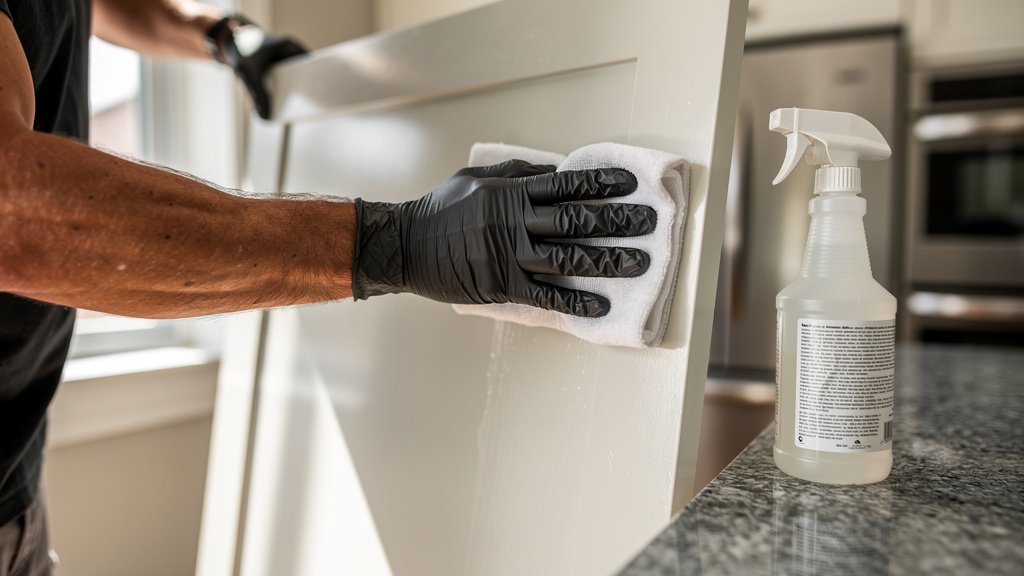
Step 2: Deep Cleaning A specialized cleaning agent removes grease, dirt, and contaminants that would otherwise interfere with finish adhesion. This thorough cleaning is essential because the process relies entirely on chemical bonding rather than mechanical abrasion.
Step 3: Liquid Abrasion Treatment Instead of sandpaper, N-Hance applies a liquid abrasion solution that chemically etches the existing finish. This creates the microscopic surface texture needed for the new coating to grip. According to their process documentation, this technique "has the same effect as sanding" without generating airborne dust or requiring intensive labor.
Step 4: Finish Application Multiple coats of finish are applied using a specialized spray system designed to deliver consistent, even coverage across all surfaces.
Step 5: UV Curing The Lightspeed Nano system uses concentrated UV light to cure the finish instantly seconds rather than the hours or days required for air-dried finishes. This instant cure creates a hard, durable surface that resists chips, stains, and everyday wear.
Can You DIY Cabinet Refinishing Without Sanding?
The good news is that homeowners can replicate the no-sand approach themselves, though with some trade-offs in durability and convenience. The DIY equivalent to N-Hance's liquid abrasion is liquid sandpaper (also called deglosser), which performs the same function: chemically softening and etching the old finish to prepare it for paint or stain.
Liquid deglossers have been used in the woodworking and finishing industries for decades. As explained by industry resources, these products "chemically softens old finishes, easing removal without heavy sanding" and "help clean the existing surface" while creating the texture needed for proper adhesion.
The difference between professional N-Hance treatment and DIY liquid sandpaper comes down to the finish system. Professional-grade UV-cured coatings offer superior durability compared to what most homeowners can apply with brushes or rollers. For budget-conscious homeowners willing to invest careful effort, though, the DIY route can produce respectable results at a fraction of the cost.
One important caveat: liquid deglosser works best on surfaces with intact finishes. If your cabinets have peeling, flaking, or heavily damaged surfaces, some sanding or scraping will still be necessary. The no-sand approach works beautifully on cabinets with dulled but otherwise intact finishes it restores shine and color without requiring complete stripping.
Cost Comparison: Professional vs. DIY
Cost is often the deciding factor between professional N-Hance refinishing and DIY. According to HomeAdvisor, professional cabinet refinishing costs an average of $3,116, with most homeowners spending between $1,992 and $4,496 depending on kitchen size and local labor rates.
Bob Vila reports that cabinet refacing a more extensive process involving new door fronts averages around $7,220, so refinishing comes in well below that for homeowners who want updated cabinets without a full replacement budget.
DIY cabinet refinishing using liquid sandpaper and quality paint typically costs between $200 and $500 in materials, plus the value of your time. However, as noted by professional finishers, "while DIY cabinet refinishing can appear to save money up front, the hidden costs both financial and emotional can quickly add up" when accounting for mistakes, touch-ups, and the time investment required.
The N-Hance franchise system positions itself in the middle-to-premium range of professional refinishing, with pricing varying by location and project scope. Their value proposition centers on the speed of completion (often two to three days versus a week or more for traditional methods) and the durability of the UV-cured finish.
What About Durability and Longevity?
One of the most common questions about no-sand refinishing is whether the finish holds up over time. The concern is reasonable: if there's no mechanical bonding from sanding, will the new finish peel or fail?
N-Hance addresses this through their UV-cure technology, which creates an exceptionally hard surface. According to their materials, the instant-cure process "causes the liquid coating to harden" immediately, producing a finish that is "resistant to stains, chips" and everyday kitchen wear.
For DIY applications, durability depends heavily on the products selected. High-quality cabinet paints (such as General Finishes Milk Paint or professional-grade alkyds) combined with proper preparation using liquid deglosser can produce results that last five to ten years with normal use. The key is following the critical timing window most liquid sandpaper products must be painted within one hour of application while the chemical etching is still active.
N-Hance and similar no-sand processes are designed for refinishing rather than completely stripping and restoring cabinets to bare wood. If your cabinets have extensive water damage, deep gouges, or worn-through finishes, more intensive restoration may be necessary regardless of which method you choose.
What to Know Before You Start
- N-Hance cabinet refinishing uses a liquid abrasion technique instead of sanding, applying a chemical treatment that etches the existing finish for proper bonding
- The Lightspeed Nano UV-cure system hardens finishes instantly, allowing for same-day or next-day completion compared to weeks for traditional methods
- DIY alternatives using liquid sandpaper (deglosser) can achieve similar surface preparation, though professional-grade UV finishes offer superior durability
- Professional refinishing averages $3,116 nationally, while DIY approaches cost $200-500 in materials
- The no-sand approach works best on cabinets with intact but dulled finishes severely damaged cabinets may still require sanding or stripping
- Proper cleaning and timing are critical: surfaces must be contaminant-free, and new finish must be applied within the product's specified window after deglossing
Whether you hire a professional or tackle the project yourself, understanding the no-sand refinishing approach opens up possibilities that seemed impossible a generation ago. The days of living with tired, outdated cabinets because the thought of sanding everything in sight was unbearable are over modern chemistry has given us alternatives that work.