What Is Mid-Century Modern Style? A Complete Guide to This Enduring Aesthetic

What Is Mid-Century Modern Style? A Complete Guide to This Enduring Aesthetic
Walk into any design-forward home today and you'll likely spot the signature elements: clean-lined furniture, warm wood tones, and those unmistakable organic curves that somehow feel both retro and thoroughly modern. That's mid-century modern a design movement that emerged between the 1940s and 1960s, shaped by post-war optimism, technological advancement, and a collective desire for furniture that was affordable, functional, and beautiful. The style emphasizes simplicity and a connection with nature while maintaining warmth and comfort, making it just as relevant now as it was seventy years ago.
What makes mid-century modern distinctive is its refusal to choose between form and function. These weren't pieces designed to be stared at they were meant to be lived with. The aesthetic was influenced by the Bauhaus movement and Scandinavian design, absorbing the former's commitment to functionality while adopting the latter's appreciation for natural materials and craftsmanship. The result was a look that felt genuinely radical at the time and somehow still feels fresh today.
When Did Mid-Century Modern Begin?
The mid-century modern movement took hold roughly between 1945 and 1970, though its roots stretch back further. The style gained its greatest popularity in North America, Brazil, and Europe during those decades, flourishing in the economic boom following World War II. Mass production techniques made modern furniture accessible to ordinary families for the first time, and developers built countless mid-century homes across suburban America.
The term itself wasn't widely used until later. Design historian Cara Greenberg coined "mid-century modern" in her 1984 book Mid-Century Modern: Furniture of the 1950s, giving a name to what had already become a cherished aesthetic. The movement grew from earlier influences particularly the Bauhaus school in Germany and its American offshoot, the International Style but evolved into something distinctly its own. It was present throughout the world, yet it felt particularly at home in the optimism of post-war America.
What followed was a remarkable resurgence. MCM-style decor and architecture saw a major revival beginning in the late 1990s that continues today, with homes featuring authentic mid-century styling commanding an 8-12% resale premium compared to similar properties. There's been roughly a 30% increase in transactions for MCM-styled homes in recent years, suggesting this isn't just a passing trend but a design language that resonates deeply with contemporary sensibilities.
Key Characteristics That Define the Style
Several core principles distinguish mid-century modern from other design movements. Understanding these elements helps you identify authentic MCM pieces and apply the style thoughtfully in your own space.
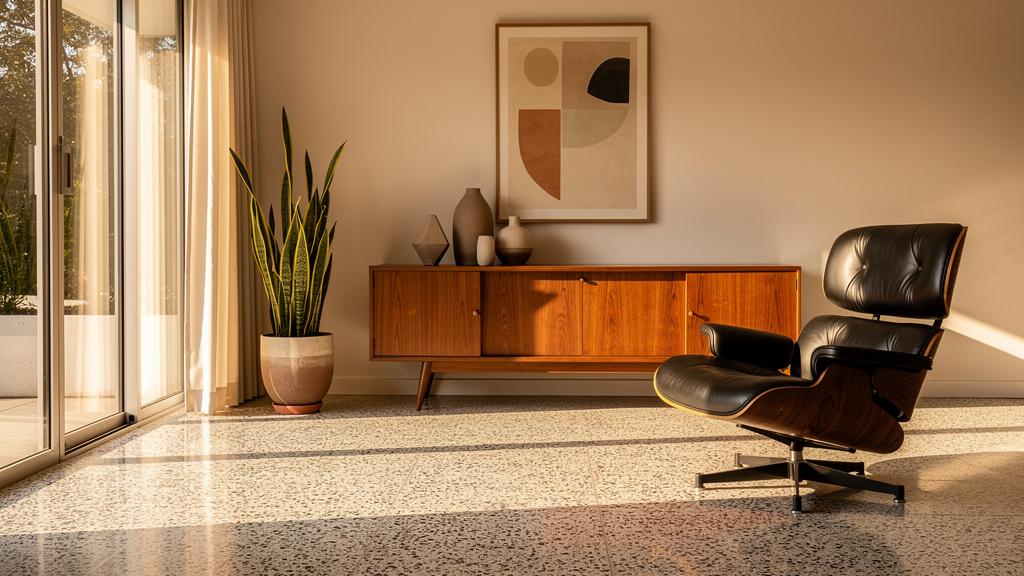
Clean lines and minimal ornamentation form the foundation. MCM furniture avoids decorative flourishes, relying instead on the beauty of the piece itself the grain of the wood, the curve of a leg, the sleek profile of a chair. There's no need for carved details or ornamental hardware when the form is compelling enough.
Organic and geometric shapes coexist comfortably in MCM design. You'll notice this in furniture with tapered legs, curved backrests, and sculptural bases. The influence of designers like Charles and Ray Eames, who pioneered molded plywood techniques, brought previously impossible shapes into production.
Functionality remains paramount. Every element serves a purpose. This isn't design as art object it's design as lived experience. The philosophy prioritizes practicality without sacrificing aesthetics, which is precisely why these pieces have endured.
The material palette embraces both natural and manufactured options. Teak and walnut dominate furniture pieces, while glass, metal, and plastic appear in thoughtful combinations. This willingness to experiment with new materials fiberglass, molded plywood, vinyl was a bold departure from what had come before.
Color Palettes and Visual Language
Mid-century modern interiors typically balance warm neutrals with bold accent colors. The woody tones of teak, walnut, and oak provide the foundation, while strategic pops of color add personality. Classic MCM color schemes draw from olive green, mustard yellow, burnt orange, teal, and warm browns hues inspired by nature that somehow feel quintessentially retro.
The trick is balance. These bold colors work precisely because they're grounded by neutral walls, natural wood, and plenty of open space. Too much of any single accent color overwhelms the clean aesthetic. Most successful MCM rooms use a dominant neutral with one or two colors as accents, whether through a single statement chair, throw pillows, or a vibrant rug.
Iconic Furniture and Designers
No discussion of mid-century modern is complete without acknowledging the designers who shaped it. Charles and Ray Eames revolutionized furniture with their molded plywood techniques, creating pieces like the iconic Eames Lounge Chair and Ottoman for Herman Miller that remain design benchmarks today. Their work offered a luxurious rejoinder to modernism's austerity.
Isamu Noguchi contributed the Noguchi Coffee Table a sculptural base supporting a freeform glass top that has been in production since 1948 (with a brief hiatus until 1973). George Nelson designed the Marshmallow Sofa and countless lighting fixtures that still define the aesthetic. Harry Bertoia's wire furniture, Florence Knoll's seating systems, and George Nakashima's live-edge tables all represent different facets of the same movement.
The enduring appeal of these pieces isn't nostalgia it's their fundamental rightness. These designs work because they solved real problems (How do you make comfortable seating affordable? How do you create furniture that fits modern open-plan living?) with elegance and wit. They weren't trying to be timeless; they were trying to be useful. That authenticity is what makes them last.

Why Mid-Century Modern Endures
The style's staying power comes from its alignment with modern values. MCM emphasizes intentional living, quality over quantity, and spaces that serve their inhabitants rather than overwhelming them. In an era of minimalism and sustainability concerns, these principles feel more relevant than ever. The emphasis on clean lines and uncluttered spaces creates visual calm something many people crave in increasingly chaotic lives.
But there's a genuine tension here worth acknowledging. The mid-century modern aesthetic has become so popular that it's at risk of becoming a cliché. When every coffee table claims to be "Eames-inspired" and every paint color promises to deliver "mid-century vibes," the style can flatten into a superficial aesthetic rather than a thoughtful design philosophy. The difference between authentic MCM and a superficial approximation often comes down to quality of materials, craftsmanship, and whether the pieces are chosen for their function rather than their Instagram appeal.
I should note that the exact boundaries of what qualifies as "mid-century modern" remain somewhat contested. Some purists argue the term has been stretched beyond meaning, applied to any retro-adjacent furniture from the mid-20th century. Others embrace a broader interpretation that includes contemporary pieces inspired by MCM principles. Both perspectives have merit the style was never monolithic, and its flexibility is part of its enduring appeal.
The resurgence shows no sign of fading. Interior design experts consistently cite mid-century modern elements as lasting rather than trendy, with one observing that "midcentury design isn't a trend it's a fixed archetype. It may wax and wane in popularity but it won't ever be out of style if properly executed." That assessment seems about right. The movement was never about following fashion; it was about solving problems elegantly. As long as people value both beauty and function in their living spaces, mid-century modern will have something to offer.