How to Clean Soapstone Countertops: The Complete Maintenance Guide

How to Clean Soapstone Countertops: The Complete Maintenance Guide
Soapstone countertops bring a distinctive matte elegance to kitchens and bathrooms that few other materials can match. If you're one of the growing number of homeowners who've chosen this natural stone, you might be wondering whether its care demands special treatment the short answer is no, but there are some smart practices that will keep your soapstone looking its best for decades.
Unlike granite, which requires periodic sealing, or marble, which etches easily from acidic substances, soapstone is remarkably forgiving. It's non-porous, naturally resistant to bacteria, and impervious to heat and most chemicals. But "forgiving" doesn't mean "no maintenance." Understanding how to clean soapstone countertops properly and when to apply mineral oil makes the difference between surfaces that look merely okay and those that develop that coveted rich, dark patina that soapstone enthusiasts rave about.
Why Soapstone Doesn't Need Sealing (But Still Needs Care)
Here's what makes soapstone different from other natural stones: it's composed primarily of talc, which gives it that characteristic soft, smooth feel, but it also contains magnesium silicate that makes the stone essentially non-porous. According to Mont Krest, a specialty soapstone fabricator, "Soapstone is bacteria resistant because it does not absorb food or liquid. Any residue sits on top of the stone and is cleaned away with simple soap and water."
This non-porous nature is why you can skip the sealing rituals that granite owners dread. But it's also why soapstone behaves differently with stains and darkening. What looks like a stain is often just the stone darkening unevenly where moisture or oils have contacted the surface. Surface Care Pros describes soapstone beautifully: "Soapstone countertops are a lot like a favorite pair of blue jeans comfortable, durable, and better with age. This type of stone tends to develop a lived-in patina that beautifully tells the story of a useful surface."
The tradeoff is that soapstone is softer than granite, rating about 2.5 to 3.5 on the Mohs hardness scale compared to granite's 6 to 7. This means it scratches more easily though those scratches often blend into the patina over time, and unlike harder stones, you can buff them out yourself without calling a professional.
Daily Cleaning: Keep It Simple
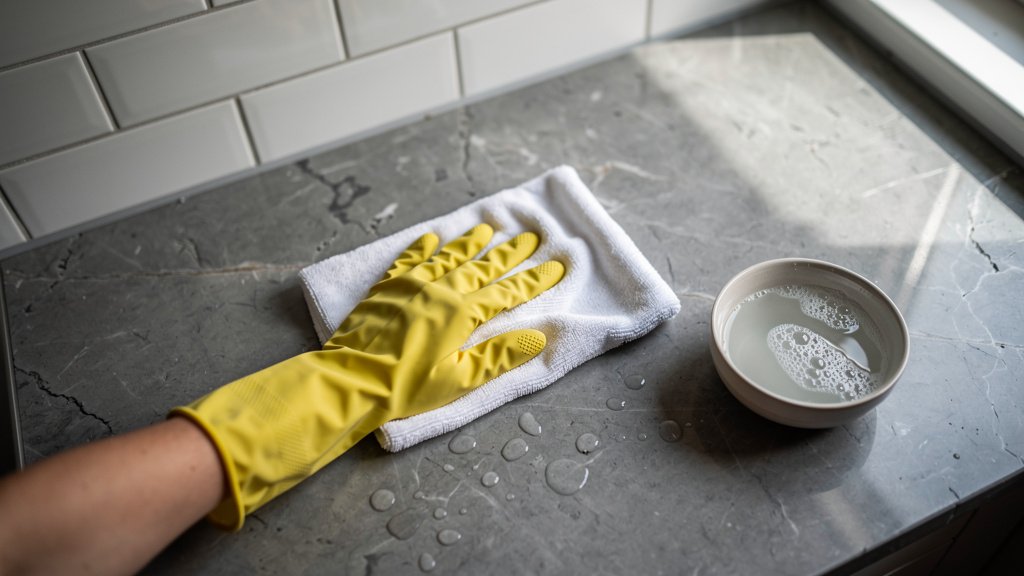
The daily routine for soapstone couldn't be easier, and that's part of its appeal. For everyday cleaning, Pacific Shore Stones recommends using "warm water and a few drops of mild dish soap. Use a soft sponge or cloth to wipe the surface, then rinse thoroughly and dry with a soft towel."
You don't need specialty cleaners. Merry Maids notes that "any common household cleaner can be used to clean soapstone counter surfaces. Chemicals and acids do not harm it." That's a remarkable claim that speaks to soapstone's chemical inertness. However, I'd suggest sticking with mild options anyway harsh chemicals aren't necessary, and avoiding them reduces any risk of skin or sinus irritation for household members.
For the daily wipe-down, here's what works: a few drops of unscented dish soap in warm water, applied with a soft sponge or microfiber cloth. Rinse with clean water, then dry. That's it. If you've been using paper towels, consider switching to a soft cotton cloth it's more sustainable and won't leave behind little paper fragments.
One thing to note: while soapstone won't etch like marble does when exposed to vinegar or lemon juice, some homeowners prefer to avoid acidic cleaners purely for peace of mind. The truth is, real soapstone (not the softer talc-based variety sometimes sold as soapstone) handles these substances without damage. But if you've got a blend or you're uncertain, sticking to pH-neutral options keeps things simple.
Mineral Oil Treatment: The Secret to That Dark, Rich Look
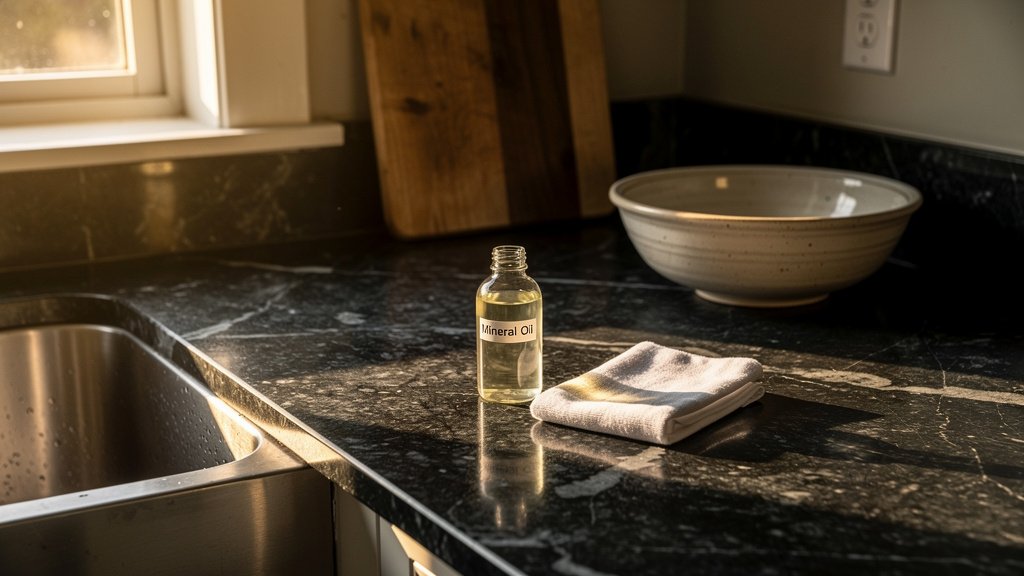
If you want your soapstone to develop that deep, charcoal-gray color that makes it so desirable, mineral oil application is the key. This isn't about protection soapstone doesn't need it but about aesthetics. The oil accelerates and evens out the natural darkening process that soapstone undergoes over time.
How often should you oil? There's no single answer that works for everyone, because it depends on how quickly your stone darkens and the look you prefer. Mont Krest recommends applying mineral oil "once a week for six-to-seven weeks to get sustainable darkening and then about every three months after that or as frequent as needed."
Bucks County Soapstone takes a slightly different approach, suggesting "Apply mineral oil to your countertops twice a week for one month and then decide what you want to do from there." The logic is that by oiling frequently during the first month, you saturate the surface and establish an even baseline color. After that, you can back off to monthly or quarterly applications based on how quickly the oil sheen fades.
Veteran soapstone owners on Houzz report oiling "an average of 2-3 times per month" and note that the process takes only about 10 minutes. If you prefer a lighter, more matte look, you can oil much less frequently quarterly or even annually works for some homeowners. The choice depends entirely on your aesthetic preference.
Applying mineral oil is straightforward: clean the countertops first, then pour a small amount onto a soft cloth and rub it into the surface in circular motions. Let it sit for at least 4 hours or overnight, then wipe away any excess with a clean cloth. TheRumford Stone company recommends this overnight wait time to allow the oil to penetrate and nourish the stone properly.
Removing Stains and Rings From Soapstone
Even though soapstone resists staining better than most stones, life happens. The good news is that because soapstone doesn't absorb liquids deeply, most "stains" are actually just surface discoloration that you can address.
For deep organic stains from coffee, wine, or cooking oil, Granite and Marble Solutions recommends using "3% hydrogen peroxide or a baking soda paste left to sit for a few hours." The approach draws out the discoloration without damaging the stone. After the treatment, rinse thoroughly and reapply mineral oil if needed to restore an even color.
For oil-based stains, East Coast Surfaces suggests wiping up spills promptly (as you should with any countertop) and, if necessary, applying "a bit of acetone (nail polish remover will suffice) on an oil stain." This helps break down the oil so it can be wiped away.
One thing to understand: what many people call "rings" on soapstone are usually just uneven darkening where glasses or cups have left moisture marks. These aren't permanent stains they're areas where the stone has darkened more from repeated contact. Regular oiling helps blend these marks into the overall patina. For stubborn rings, gentle sanding with fine-grit sandpaper (400 to 600 grit) can level the surface, but this is rarely necessary.
Common Mistakes to Avoid
Mountain Empire Stoneworks warns against using harsh chemicals or abrasive materials, which can damage the stone's surface even though soapstone is tough. Skip the steel wool, abrasive scrubbers, and strong cleaning solvents. They're not needed and could leave marks that are harder to remove than whatever you were trying to clean in the first place.
Another mistake? Assuming soapstone is indestructible. While it's heat-resistant (you can set a hot pan directly on it without the damage that would cause granite to crack), it's not immune to abuse. Heavy impacts can chip the edges, and while those chips can be repaired with sanding, prevention is easier.
Some homeowners make the error of applying commercial stone sealers to soapstone. Don't. Mont Krest explicitly states: "Unlike granite and marble, soapstone does not need to be sealed with chemical agents. In fact, we recommend that it not be sealed." The sealer can create a hazy film that sits on top rather than soaking in, and removing it later is a hassle.
How Does Soapstone Compare to Other Countertop Materials?
If you're weighing soapstone against granite, marble, or quartz, the maintenance differences are significant. Granite requires periodic sealing to prevent staining. Marble etches easily from acidic substances and needs more careful maintenance. Quartz is engineered to be low-maintenance but can be damaged by excessive heat.
Soapstone's advantage is simplicity: no sealing, no special cleaners, no professional repairs needed when something goes wrong. It's also uniquely heat-resistant you can take a pan directly from the stove and set it on soapstone without worrying about thermal shock or burn marks. This makes it particularly popular in home kitchens where cooks appreciate the practicality.
The trade-off is aesthetic: soapstone's matte finish and limited color range (generally gray to black) won't appeal to everyone. And yes, it scratches more easily than granite. But for many homeowners, those scratches become part of the stone's story evidence of a well-used, well-loved kitchen.
Key Takeaways
- Clean soapstone daily with warm water and mild dish soap no special cleaners needed
- Apply mineral oil regularly to develop the rich, dark patina soapstone is known for; start with weekly applications for the first month or two, then reduce to monthly or quarterly as desired
- For stain removal, use hydrogen peroxide or a baking soda paste for organic stains; acetone works for oil-based marks
- Never use abrasive pads, harsh chemicals, or commercial stone sealers on soapstone
- Understand that scratches and uneven darkening are part of soapstone's character most owners embrace these as signs of a well-used surface
Soapstone rewards the laid-back homeowner. You don't need to fuss over it, but a little regular attention a quick daily wipe-down and periodic oiling keeps it looking beautiful for decades. The minimal maintenance is part of the appeal: instead of worrying about your countertops, you can just use them. And really, isn't that what a kitchen surface should be for?